What motivates you? This past Saturday morning, the Madison, Wisconsin Team in Training Cycling Team was scheduled to have its first outdoor ride of the season. It was supposed to be 30 miles. Mother Nature, however, had other ideas. While we had no new snow, we did have a wind chill of 10 degrees and some ice on the road. As coaches, we made the decision to do a "hybrid" workout. An hour spin class followed by a short 8 mile ride outside. That way, we got a decent workout in and got to spend some time on the road, and for that there is truly no substitute.
Rebecca, another Team in Training Coach, and our spin instructor asked us during the workout "What motivates you?" She was asking for the reason we get up early on a Saturday to come to spin class and ride to nowhere and follow that up with a cold ride in the elements? That was a good question, and one I thought about for the rest of the ride.
We all have our reasons for doing the things we do. Figuring out why we do them can be a difficult task. For me, I think it comes down to the title of this post "Winners always want the ball." This is a quote from the 2000 movie "The Replacements" starring Keanu Reeves as Shane Falco, a professional football replacement quarterback, and Gene Hackman playing Jimmy McGinty, his coach. In the movie, The coach has called a pass play, and Falco calls an audible changing the play. He hands the ball off to the running back who fails to score and the game is lost. The coach tells Falco, "If I wanted him to have the ball, I'd have called it that way." McGinty goes on to tell Falco that he got scared. He finishes by saying "Winners always want the ball...when the game is on the line."
That is true. Winners do want the ball. I'm not necessarily talking about sports figures, and the people that score the most points. I'm talking about successful people. They always seek out opportunities for growth and success. They want to have the responsibility for what happens. No matter the outcome, they own it.
That's what motivates me. Success. When I was a Detective with the Mobile County, Alabama Sheriff's Office, and there was a big investigation, I wanted the case. If there was a bad guy that needed to be interrogated, I wanted to do it. I had faith in my ability, and my training, and I wanted the responsibility. I wanted the ball!
In coaching, I want the responsibility of helping athletes cross the finish line. Again, I have faith in my ability. I want the weight on my shoulders because I can succeed and I can help others succeed. I want the ball!
Now for the hard part. How do you cultivate that faith? How do you get that confidence to ask for the ball? I think it's different for everyone. For me it comes down to two things. First, hard work. Doing more than necessary, more than expected. It's putting forth that little bit of extra effort needed to make you better. I think this will explain it better than I could...
That one extra degree makes all the difference. A series of small efforts add up to huge successes.
The second thing that helps me have the confidence to step up and be successful is not being afraid to fail. You must embrace the idea of growth and attempting those things you've never tried. To get what we've never had, we must do what we've never done. Contrary to the famous line in Apollo 13, failure is ALWAYS an option. The person who never fails, has never tried. If you knew before you tried something that success was guaranteed, then what's the point?
Thomas Edison said that many of life's failures are people who didn't realize how close to success they were when they gave up. Never give up. You haven't failed, you just eliminated another way that doesn't work.
Start cultivating that winning attitude today! "Winners always want the ball." Believe that you can do it. You won't always win, you can't always win. But that's ok. Knowing that you can do it is what puts you ahead of the competition. That's the "extra degree". Great actors want the lead role. Great speakers want the tough audience. Great detectives want the bad guy that refuses to confess. And, when the game is on the line, winners always want the ball!
Spring
is in the air (at least everywhere but Wisconsin,
apparently) and it’s just about time to get on our bikes and head outside!Here in Madison,
the Team in Training America’s Most Beautiful Bike Ride Team is preparing for
our first outdoor group ride!With this
being the current weather forecast…
this
may or may not happen, but it’s time to be prepared anyway!It’s time to start thinking cyclogically! The
purpose of this post is to throw out some basics of group riding.Riding in a group can be very fun and social
but you have to be safe.Every regular
group I’ve ever ridden with has its own personality, and its own way of doing
things.If you join an existing group,
you’ll figure it out pretty quickly.If
you start your own group, it will develop its own personality over time.These are general tips that should apply in
any group at any time!
Be
Smooth and Predictable.Make sure you don’t
have sudden accelerations or slowdowns.If
a gap opens up in front of you, close it slowly and gradually. Use sharp
braking ONLY in emergencies! Always check your blind spot and know what is
going on around you.
Communicate!
Learn the hand and voice signals of the group you are riding with. Let everyone
know if the group is slowing or stopping.Signal all turns with hands and voice.Let other riders know when hazards are approaching by pointing to them
and calling out whatever the hazard may be. Let others know where vehicles are
(Car back, Car up, Car right).Communication
may be the single most important factor in riding in a group!
Be
considerate to others in the group.If
not everyone makes it through a stop light, slow down to wait for those that didn’t
make it through.We should all be
following the rules of the road and not violating traffic laws, so this will
also encourage safe behavior since people won’t have to worry about losing the
group.
Let
others know when you are passing them.Always pass on the left. Never pass on the right.As you approach a slower rider call out “On
your left”, so they know you are there, and they don’t pull out to pass a
slower rider and crash into you.
Watch
out for those riders that may be less experienced, or a little squirrely.Increase your following distance around
them.Find those riders who are
comfortable and steady, and try and position yourself around them.
Never
ride in aerobars in a group. You need to be in complete control of your bike,
and that’s not possible if you’re in areo position.
If
you’re like most people, when you first start riding with a group, you’ll be
nervous and a little scared.Don’t worry.
As you spend more time riding with a group, you’ll become more comfortable and
really begin to enjoy it.Before you
know it, you’ll be group riding like a pro!
Alright, Ninja followers!Here it is…the report you’ve all been waiting for.How I Escaped from Alcatraz!
Pre Race:
Flew into San
Francisco on Friday and made it to the hotel.The Argonaut, close to Fisherman’s
Wharf.It ended up being the perfect
place to stay because it was walking distance from where I rented my bike, and
about a mile from Marina Green, where transition and the finish line is
located.After checking in, I went and got
the bike from San Francisco Bike Rentals (I know…creative, right?) and went for
a ride across the Golden Gate
Bridge.It was an awesome and beautiful ride, and
definitely recommended for anyone visiting San Fran!After crossing the bridge, we rolled down to Sausalito for a nice stroll and coffee before taking the
Golden Gate Ferry back across the bay to San
Francisco.The
ferry was $9.75 and well worth it.You
can find boats offering $20 tours of the bay, but in my mind, the ferry back
across is a better deal.There are
amazing views and you pass right by Alcatraz.That gave me a good look at where I’d be
swimming on Sunday.The first thing you
realize is that it’s a LONG way from the prison to the swim exit.Looking at the wind, waves and current, I
realized why this swim is regarded as so tough.
Friday night and a trip to Sports Basement was in
order.As many of you may know, my
current favorite pro is Jesse Thomas.Love reading his race reports, and I'm a big fan of Picky Bars! If you don’t
know about either, the appropriate links are here --> http://leapdaysports.com/ and http://pickybars.com/ If you’re an athlete you
need to try Picky Bars!Anyway, I had
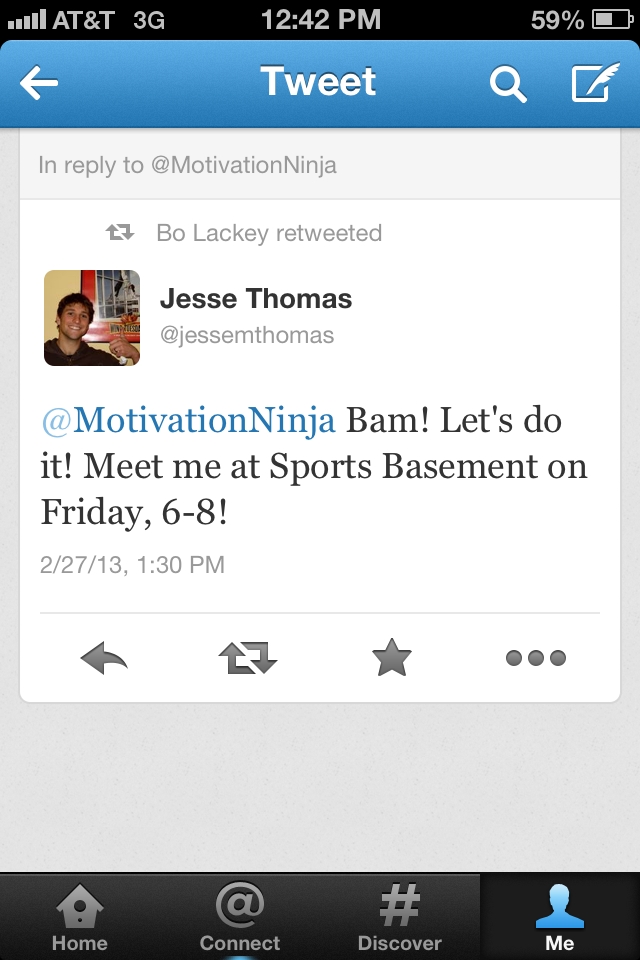
tweeted Jesse earlier asking for the possibility of a meet and photo…and to my
surprise…
So I get to Sports Basement and find Jesse at the Picky Bar
table with his better half, Lauren.We
talk for a few minutes, and I give Jesse some pointers for the race and then we
have a photo op.
Jesse’s trademark are
the aviator glasses.I see them, and the idea strikes.I
tell him “This may be in bad form, but could I get a picture wearing the
aviators?”He takes them off his head
and says “This may be a first.”He hands
them over saying “Be careful, I don’t want to have to go back to Walgreens!”
Classic!What can I say…he’s a great guy!And my advice must have helped.He took third place and was the first American finisher.This is one of the things I love about this
sport, the opportunity to race with and against the professionals and to find
out how down to earth, real, and genuine they actually are.Jesse, if you somehow manage to read
this…Thanks (and add a comment to give me some street cred!).You made my weekend! If you
ever come to Madison,
I owe you big time.
Saturday dawned and we decided to see some of the city by
bike.Farmers Market, Fisherman’s Wharf,
Golden Gate Park, Haight Ashbury, we saw it all.A trip to packet pickup to get body marked
(they mark your hands? Really?)
and then a short walk to the swim exit.Now, you’ll recall I thought it was a long
swim when I saw it from the ferry at Alcatraz?
Well, looking at it from the swim exit, I realized it’s a REALLY LONG way!
It
was fun watching others walk up and make the same realization. Since the hotel
was so close to Aquatic
Park, we saw a lot of
people trying out the water and getting in practice swims.I decided that at this point it wasn’t going
to make any difference anyway, so there’s no point in unnecessary pain and
discomfort!So, it was off to bed in
preparation for the escape attempt!
Race Day:
Let me begin this by saying it was an amazing day and an
awesome experience.As I try to describe
it, I realize that this is a lot like a beautiful view.You stand in amazement while looking at it,
but as soon as you try and take a photo, you realize there is no way you can
capture the true beauty and wonder.I
don’t think there are any words to fully describe the experience and on some
level, I know this will be wholly inadequate, but here goes!
As I leave the hotel in the darkness of the morning, I know
it feels cold.Air temperature is about
52, but with the wind it feels mid 40’s.Now that’s not cold at all for Wisconsin,
but for race morning it was chilly.I
plan to ride the mile or so to transition, and as I leave the hotel, I fall in
with other triathletes also riding there.It’s dark and quiet as everyone get into their own “race space”.I make it to transition and get everything
set up rather quickly.Once that’s done,
I make my way to the buses.At this
race, since it starts from a boat, organizers bus you from transition to the
boat landing.Getting on the bus, we’re
thankful for the warmth, and people start the usual nervous pre race
chatter…Where are you from? Are you ready? Why are we doing this?We get to the landing, and since I’ve heard
the boat described as a “ferry” I’m not sure what to expect.This is what I see
She’s a beautiful boat, and our home for the next hour or
so.Again, thankful for the warmth,
athletes make our way onto the boat and volunteers direct us to different decks
based on our swim cap color.I have a
yellow swim cap and I’m directed to the second deck.Once there, there’s a bar at one end,
carpeted floors and real bathrooms! (if you’re used to thepre race port-a-potty you understand the
joy).Athletes are talking, sleeping,
doing yoga, eating energy bars and generally trying to contain pre race
nerves.The boat leaves the dock at 6:30
and the race is scheduled to start at 7:30.That means, we get on site and have a lot of time before the race
starts.Everyone crowds to the side to
look at the conditions.We see white
caps in the bay, and a strong current pushing kayaks around. We also start to look at our sighting land marks.Now, because of the current in SF Bay, you
can’t swim directly toward the swim exit.If you do, you may be pushed so far of course you can’t make it back,
and you risk being swept out to sea. (not really, there’s too may safety boats
for that, but without the safety boats, kayaks, etc. it’s a real risk).After looking at the current, the waves, and
the distance one woman near me starts to freak out and her friend calms her
down telling her “You can do this.You’ve trained. You’re ready.”And this has a calming effect on everyone around. We hear a voice
reminding us that this is no time to be weak.The water is cold, there is a current, there are 2,000 athletes that
need to be off the boat in 6 minutes.The tension is getting thicker as race time approaches.Then we see a cruise ship entering the bay
under the Golden Gate
Bridge.As we all watch the ship, we’re wondering
what this means…surely we won’t have to dodge a cruise ship too?Not with the wind,the cold water (51 degrees), the current, the
waves, and the “marine life” (sharks)?Then we’re told the race will start a few minutes late to let the cruise
ship pass.Finally we hear the national
anthem, and from the side of the boat watch as the pros dive in and take
off.Then, about 30 seconds later the
age groupers start.We’re able to watch
the first few and we see that nobody seems to be swimming the way they told us
to.Everybody is swimming straight to
the swim exit.Then we realize, no,
their bodies are pointed the right way, but the current is pushing them.It’s that strong!Oh well…too late to do anything about it
now.I thought that Ironman was the
craziest swim start in triathlon.I was
wrong!This is crazy.Everyone starts moving towards the stairs and
being herded like cattle.The mass of
humanity moves slowly but steadily down the stairs.As we approach the first deck, I can see the
door.As I make the turn, I realize the
jump off point is right there. Nothing else to do, no time to think.You cross the timing mat and jump…
The Swim:
Two thoughts occur almost simultaneously 1. %#&$ it’s
COLD!!!! And b. someone is about to jump on top of me!Without a doubt the craziest swim start
ever.The jump is only a few feet, but
seems much farther.The water is
amazingly, incredibly, unbelievably cold!At first it hurts to put your face in it.You take a moment and find your landmarks.
Then start swimming.After about 5
minutes your face and hands go numb, and it’s not so bad.I was told that there were up to six foot
swells reported in the bay that morning, and I’m sure the last minute cruise
ship didn’t help. The current was pushing you out towards the Pacific
Ocean, and the wind was blowing in from the Pacific, so it gave
you what I heard someone very aptly describe as the sensation of swimming in a
washing machine.If you want to know
what it was really like, check out the video:
Now here’s the really freaky thing about this swim: Even
though there are 2,000 athletes out there and hundreds of boats, kayaks, etc.
because of the fact that they are no buoys for navigation (you sight entirely
on the shore) and because of the swells, ten minutes into the swim you feel entirely
alone.You don’t see anyone. It’s easy
to imagine what it would have felt like to actually attempt to escape from Alcatraz. Every now and then, if you time a breath just
right, you can see another swim cap, but there can be someone a few feet from
you and you don’t know it.In a word:
scary.In another: exhilarating!
I’m a relatively strong swimmer, and this was the toughest
swim of my life.I later found out that
they pulled and “repositioned” about 150 swimmers or around three times the
normal number.I talked to other
athletes that had done this race before and they said it was much harder then
usual.And yes, if you heard the news,
there was one death reported during the swim. (not a drowning though, cardiac arrest at the start. Water safety crews saw him immediately and attempted CPR, but unfortunately, it was not successful. My heart goes out to his family and friends). It was tough.With large swells, and wind, It was hard to
time your strokes and your breath to the waves and wind.It was hard to sight, and hard to judge the
current.I felt strong most of the race,
remembering that smooth is fast, and focusing on technique, not strength.As a result, I almost overshot the swim exit
and my last few hundred yards were against a stronger current than I would have
liked, but I made it.I got to where I
could stand and realized immediately this had been no ordinary swim. I found it
hard to stand as I had “sea legs” and trouble keeping my balance.As I tried to take off the neoprene cap and
unzip my wetsuit, I realized that my fingers were totally numb and I had no
manual dexterity whatsoever. But, the swim was complete!No matter what happened the rest of the day,
I would always have a successful Alcatraz swim
crossing on my athletic resume!
T.5 :
Escape from Alcatraz is
unique in that there is a half mile “warm up run” from the swim exit to
transition.You have the opportunity to
have a bag there for a towel, run shoes, water, etc.Because of the weather, I wasn’t sure if I
was going to wear my wetsuit (fully or partially)on the way to transition for warmth or
not.As I found my bag, I was feeling
pretty good and warm, so I opted to strip off the wetsuit and throw on a pair of
shoes.I had also put a wool knit cap in
the bag, and decided to wear that on the half mile run to keep any warmth I
generated.One of the smartest decisions
all day.So with the swim behind me, and
feeling amazing, my focus changed from survival to having fun.
T1:
I run into transition feeling good and I find my bike fairly
easily in a sea of 2,000.I take my time
getting ready and focus on being smooth.I had arm warmers in transition and compression socks available on the chance I was
cold, but decided not to use them. I went with full finger bike gloves and a
very light Team in Training windbreaker and headed out for the 18 mile
bike.T1 was slow, including the half
mile run from the swim exit, but I wouldn’t have changed a thing.
Bike:
18 miles.Doesn’t
sound like far, but on this course, It’s pretty tough.Heading out the first couple of miles is flat
and into a slight head wind.It’s not
too bad, because you realize that on the way back you get the tail wind.Then you start climbing.Up and up to the Golden Gate Bridge.At this point, I hear sirens and start to see
SFPD and CHP motorcycles coming down the hill at an amazing clip.I see the CHP bikes and get the theme song from
the 80’s show CHiPs stuck in my head where it stays for the rest of the bike,
but that’s another story. (Hopefully you'll have it stuck in your head now too!)
Seeing the cops I think "no way, not already"…and right
then, Javier Gomez flies past me on the down hill like a bullet.Within a couple of minutes,Graham O’Grady and Jesse Thomas go by like
blurs too.Man, I want to be like them
when I grow up.Top the first hill and
then head downhill again.Up and down,
right and left. Up to the Palace at the Legion of Honor, then downhill.Crazy fast downhills that seem fun until I
realize that I have to come back up these hills. Just past mile 10, I looked to
my right and there were buffalo!Buffalo on the bike course in Golden Gate Park.
One more reason this is the coolest race ever. During one of the stretches you
pass through a residential are and past the house of Robin Williams.I had read that if he’s in town, he’d be
outside cheering.Guess he wasn’t in
town.Oh well.Heading
back towards transition I have the wind at my back, the bike behind me, and I’m
looking forward to the run. Here's a video of the bike course in under 4 minutes!
T2:
Pretty uneventful, try to drink some, a change of shoes,
talking to fellow competitors, a quick bathroom stop, and I’m off for the 8
mile run.
Run:
The run is 8 miles.Like the bike, the first part is flat, and again like the bike, then the
climb starts.This is a tough run because
once the climb starts, it is virtually impossible to pass. The course is mostly
out and back, so you have to deal with runners ahead of you, behind you, and
head on. Trail run and stairs, through an old tunnel at the Presidio and up to
run under the Golden Gate
Bridge.The run continues to take its toll and you
keep climbing on a very slow and technical course.I have to watch my footing almost every
step.At the top of the hill, then there
is a long descent along the road until you turn to a trail that heads down to Baker Beach.Once you hit the beach you look and almost a
half mile away is the turn around.The
signs clearly indicate that you are to stay to the left and run in the heavy
sand, but some people aren’t paying attention and head to the water where its
harder packed and easier to run.Me, I don’t
do that.I choose the heavy sand.I’m pretty sure that there would be no
penalty, and no one would know, but I would know that I cheated the course and I
cheated myself.Running in sand like
that drains your muscles and your spirit.I make the turn around and get to run along the water.It feels much better on my legs, but the sand
I pick up on my shoes is wet and heavier.Then comes the sand ladder. One
of the things that makes this race so tough, so punishing, so challenging, and
so fun. About 400 “steps”.Actually logs
or landscape timbers chained together and covered with sand. Here's a video I found of the experience.
People groaning, bitching and moaning.I, on the other hand am loving every second
of it.To everyone that complains, I
say, “Come on, you know this is one of the reasons you signed up for this
race!Let’s get our money’s worth!”“This is why we’re here!” “Enjoy the moment!”Halfway up the sand ladder is a race photographer.
This should give you an idea of my mental state at this point…
Once you get to the top of the sand ladder, it’s still not
over.You still have about a half mile
of climbing before reaching the top.During this point, you're again on the out and back portion so people are
heading downhill to the beach.You can
tell that a lot of them are looking for signs of pain on the athletes coming
back up.I refuse to give it to
them.Instead I start encouraging them,
telling them it’s worth every step.I
know from experience how much of a difference it can make hearing things like
that.I also know that you never know
who you’re going to inspire!
After cresting the hill and taking a moment at the mile 5
aid station to empty sand from my shoes and thank as many volunteers as
possible, (Especially the guy dressed up as cookie monster)
I head off for the last three miles.I
come around a bend and see an amazing view.Up on a bluff, with the Pacific Ocean stretched out forever, and the
most beautiful view of the Golden
Gate Bridge
I’ve ever seen, I slow down and realize how lucky I am to be there at that
moment.Just a few minutes later, I run
back under the Bridge and can see Alcatraz Island in the distance and am awestruck
for a moment that I actually swam from there to start the day.The last couple of miles were flat with a
tailwind and I try and spend the time reflecting on the day and everything it
took to get there since finding out I won a lottery slot.Approaching the finish at Marina Green, is very
cool…more and more people are lining the route cheering you on.The finishing chute is long and ends with
grandstands on both sides.I crossed the
finish line and, being careful to make sure I wasn’t blocking anyone, I dropped to the
ground.I think a few volunteers started
heading my way thinking I was in trouble and had collapsed, but then I did my
push up and jumped back up to finish my burpee… with a whole lot of gratitude.
Post Race:
I’ll post all my splits, even though they are
incredibly unimpressive.My goal was to
have fun, finish, and enjoy every moment. I did that.Looking back, I could have been faster.I could have pushed myself harder.But I honestly don’t think I could have had any
more fun!This is a race that every
triathlete should do once.It’s tough,
it’s challenging, and it’s fun.
Feel free to leave a comment and if you have any questions, please ask. All in all, it was a great first race of the season, and I can't wait to see what else the year will bring!
Race week is here. A time to hydrate, eat well, and rest. An act known as the taper. Part science, part art. A time to recover from training and make sure my body is rested and ready to perform at it's best on event day. Sounds great, right? Only one problem. When I decrease the amount of physical work and stress there is a proportional increase in mental work and stress.
Have I done enough? Wouldn't "one more" long swim/spin/run help? Especially trying to prepare for a race on Sunday when snow is in the forecast today! This is not the first time I've trained for an event in March, but this is the first time I've tried to prepare for a race in early March while living through a Wisconsin winter! Ever tried an open water swim in Madison in February? Ask my patron saint how well that works... Saint Happenin! Almost every bike ride has been in a spin class or on my trainer (with the exception of commuting to work, and if you remember from a previous post, black ice causes crashes!) The only thing I've been able to do consistently outside is run, and while snow can be a reasonable substitute for the sand I'll experience in Escape from Alcatraz, ice often makes the run much more a core workout than one for the legs.
So, all of these doubts start to creep in. I haven't done a true open water swim in months. Can I even swim farther than 25 yards without pushing off the wall? Am I ready to fight the cold water temp, currents, and marine life (read SHARKS)?? How about the bike? I hear the hills are brutal in San Francisco, am I prepared for this after a winter of biking indoors? I'll be on a rental bike, not even my own trusted steed. What if it doesn't fit right? Or has a mechanical issue? And the run...oh the 8 mile Escape from Alcatraz run... including massive hills, sandy beach and the dreaded sand ladder? I've been running this winter, but am I really ready for this? Can I do it??
I begin to feel scared, nervous, and completely under prepared. Let's face it, this is one of the most challenging open water swims there is, and then I have to bike and run? But then, I take a moment and go back to the three fundamentals of alignment yoga: grounding, full commitment exhale, and relaxing the roof of my mouth. I then realize these feelings are exactly the reason I attempt these events. I love the challenge of conquering these fears. I know that once I get in the water for the swim, I'll have a moment of panic. It happens every time. A "what am I doing here? why am I doing this?" moment. But then, I relax, focusing on my swim strokes, feeling the water glide past me as I feel strong in the water. Exiting the swim and heading for transition trying to remember that smooth is fast. Getting on the bike and trying to find the perfect combination of pushing myself and staying comfortable so I have something left for the run. Completing the bike and starting out on the run trying to stay strong until my day takes me to the finish line. The challenges are what makes it fun and worth doing.
This time seems to be different, though. Maybe its because I've had to train through the winter in Wisconsin. Maybe it's because it is such an iconic race that (unless you're either a professional, or crazy fast) you have to win a lottery slot to even get in. Or, maybe it's because I know I'll have so many people cheering for me from so many places around the country. Friends, family, coworkers, Team in Training athletes and a host of others hoping I complete something that some of them want to do themselves, and others admire me for the effort.
It would be so easy to get caught up in the fear, worries, and anxiety. Instead, this week I have a new manta (mantra: a sound, syllable, word, or group of words that is considered capable of "creating transformation").
I am using this phrase to help me remember, this is not a race, it's an event. I don't want to feel fast, I'd rather feel strong. No matter what happens, I know I have trained enough to complete this event. It may not be my fastest time ever, but that's OK. I will take whatever the day gives me, and I will take it with gratitude. I will be grateful that I am healthy enough to compete. I will be grateful for an amazing venue and a beautiful course. I will be grateful for a course that tests me physically and mentally. Most of all, I will be grateful for all the people supporting me, cheering for me, and wishing me well. And, if the universe allows me to get to the finish at Marina Green, and successfully Escape from Alcatraz, I promise to cross that line with gratitude...and a burpee!
Well, here we are in late February and personally, I'm hoping spring is right around the corner! With spring will come longer rides on the bike. I know I have some friends who are newer to cycling, and some friends who are looking at buying a new bike. I can not stress the importance of a professional bike fit enough. It will help you get the most out of your riding time, with the least amount of discomfort and pain. Those small nagging aches and pains can truly suck the joy out of those long rides.
It is important to remember that bikes come in a limited number of sizes. Riders do not. But there are dozens of small adjustments that a professional bike fitter can make to get your bike to fit you perfectly. A good bike fit will accomplish several things. These include
Improve overall rider comfort
Help prevent cycling-induced repetitive stress injuries
Reduce or eliminate back, knee, neck and wrist pain
Reduce or eliminate “hot foot”
Reduce or eliminate saddle discomfort and genital numbness
Reduce or eliminate numbness in the hands and fingers
Reduce rider fatigue
All of these can be extremely important. Especially if you're planning on riding 100 miles around Lake Tahoe during America's Most Beautiful Bike Ride!
During a bike fit, a professional fitter will look at many different things. The first thing they should do is just talk to you. Find out about your cycling history, your goals, how much you plan to ride, what type of riding, and if you have had or currently have any injuries. Then, if you haven't bought a bike yet, the fitter may have you sit on and try many different bikes to see how they feel, or they may use what is known as a "fit bike" This is a stationary bike that allows numerous adjustments to be made to the frame, pedals, handle bars, etc. In this way you may be able to find what measurements feel good to you, then you can look for a specific bike that fits you. If you already have a bike, or once you have chosen one, the fitter can put that bike on a trainer and then make the necessary adjustments to make it fit you. Depending on your goal, a proper fit might be the one that generates the most power, or it might be the one that is the most comfortable. Most people like to find a good compromise between the two.
A typical fitting can include setting clipless pedal cleats in the correct orientation and position if you are using clipless pedals, setting your seat height and position, evaluating shoes and insoles and determining correct stem length, handlebar height and handlebar width. It is important that you take your riding gear with you to a fit. Whatever you are going to wear while riding should be worn during a bike fit.
Schedule your fit as early in the season as possible. This will allow
your training rides to feel better and be more productive, and it will
allow your body to become used to the position and get stronger. It is
also a good idea to go back to the fitter once or twice as your body
adapts to the position. You may be able to find adjustments to add to
your comfort or power. Both of which can greatly add to your
enjoyment. Check around with different shops and see what they offer,
how much they charge, and what is included if you buy a bike. Remember,
professional bike racers can get incredibly faster by making
adjustments involving millimeters. A professional fit is a cost that
will pay for itself with increased comfort and fun!
Two weeks from today, I'll be preparing to Escape from Alcatraz. If you've never heard of it, it is an iconic triathlon in San Francisco. It begins with a 1.5 mile swim from Alcatraz into San Francisco. 55 degree water, marine life (Sharks, seals, sea lions, etc.) and a strong current. If I survive the swim, them I have a half mile run to transition where I'll start an 18 mile bike through San Fran hills. Finally, I'll tackle an 8 mile run over hills, on the beach, and up the dreaded "sand ladder". If you want more info, you can go here...
About the only way to get into this race is by lottery. It seemed like such a good idea last summer when I entered the lottery. It even seemed like a good idea in October when I won the lottery slot. I obviously did not take into account the fact that it's difficult to train during a Wisconsin winter. After lots of laps in the pool, hours on the trainer and in spin classes, and many miles of cold runs through snow and ice, I have to admit it still seems like a good idea! The only time I questioned it was a few weeks ago when I was riding my bike to work and crashed after hitting a patch of ice. Huge bruises were painful, but not the main problem. I hurt my shoulder when I went down and spent a couple of weeks out of the pool and trying to heal. Finally I went to my doctor, who is a cyclist and athlete and understands the importance of events like this. The first half of the appointment was spent discussing the race and looking at the course online. I love my doctor! When we finally got back to diagnosing my injury, after much manipulation, and range of motion tests, he determined that I had a minor rotator cuff strain and could get back to training. So, I've been back to 2600 yard swims preparing for San Francisco Bay.
It's hard to believe I'm racing in two weeks when my 8 mile run today was in 14 degree temps with a wind chill of 2. But, at least, snow is a reasonable substitute for sand! And there will be lots of sand... the sand ladder is basically 400 steps consisting of landscape timbers connected together and covered with sand leading from the beach, back up to the road. I'm told even the pros walk it. Must be brutal. Sure looks like it!
All indications are it's a incredible race in an amazing location. And with a swim from Alcatraz to San Francisco, what's not to love?
As I'm running today, I was thinking about all the things that I am currently doing, or attempting that I would never have dreamed of. Some things as large as Ironman Wisconsin, or a swim from Alcatraz and others as simple as commuting to work year round by bike in all weather. It's not that long ago that I never would have willingly gone outside with a wind chill of 2 degrees, much less run 8 miles it. Hell, it wasn't that long ago that I thought that running 8 miles at all would have been an impossible task. It's funny how perspective changes and makes things that seem impossible, attainable.
I wonder what I'll do tomorrow that seems impossible today? What will you you do?
"There is no such thing as bad weather, only soft people." - Bill
Bowerman (co-founder of Nike)
While this line may be true for die hard winter athletes, another way to say
this is "There is no such thing as bad weather, only unsuitable
clothing." For those of us that choose to ride year round, I think
both quotes are true. The proper clothing can make the difference between
a frozen sufferfest, and a comfortable ride.
Coming from the Alabama
Gulf Coast
where lows in the 30's are considered frigid, I would never have believed that
I would become a year round bike commuter. Now, temperatures in the single
digits are commonplace on my rides and temperatures and wind chills well below
zero are not that rare. I'll share some tips for cooler weather cycling.
With the right gear and mindset, cycling can be pleasurable year round.
First things first. You usually don't need nearly as much clothing as
you think you do. The body naturally produces a great amount of
heat. You should feel slightly cold when you start your ride. On
average, dress for your ride as if it is 15 degrees warmer that it actually
is. If you dress too heavily, you will begin to sweat and when you stop,
that sweat will make you feel much colder. If you dress too lightly, you
will never get warm and it will be a cold miserable ride with blocks of ice for
fingers and toes accompanied by the feeling you will never get warm again for
the remainder of your life. It is a balancing act that comes with
practice and experience. It has taken a while, but I now know exactly what to
wear at any given temperature with any given weather conditions.
So, let's look at some general tips for cycling in the cold. Layer.
That is without a doubt the most important tip. The overall purpose of layering
is to trap insulating air between layers of clothing and subsequently hold heat
in. A good base layer should fit close to the body and be of a material that
wicks moisture away from the body. Wool, polyester, or nylon/spandex are
all good choices. NO COTTON. When you sweat, cotton will just act
like a sponge and leave you feeling wet, heavy and cold! Depending on how cool
or cold it is, you may just want to use arm warmers in addition to a cycling
jersey. This way, as you warm up, they can be taken off and stuffed in a
pocket. (Keep in mind, we are a long way from that option in February in Wisconsin!)
The next layer should have thermal capabilities. Polyester and fleece
are good choices. Something that will trap the heat, and also allow
"breathing". Most modern synthetics are excellent choices.
The outer layer should serve two purposes: keep warmth in and block the cold
air and wind. There are many companies that produce great garments for this
purpose. I wear a Gore Windstopper jacket.Lightweight, but blocks the wind amazingly and has zip off sleeves if
the weather makes just a vest more practicable. Great tip...if while on a ride you feel you
need better wind protection, use newspaper under your jersey. You will
see pros and amateurs alike use newspapers for long, cold descents. Newspaper
blocks the wind in the front and keeps heat from escaping in the back.
Now let's move up to the head. You lose a tremendous amount of body
heat through your head. If you keep your head warm, your body will stay
warm as well. Depending on how cold it is you have many options. Do not
however count on your helmet to keep your head warm. Helmets are vented
to allow air flow which will keep you cool in warmer weather, not designed to
keep warmth in. You can use a synthetic cap, or ear warmers to begin
with. If more is needed, a warmer wool cap can be used, or even a full
hood (called a balaclava) can be used. This covers the face, head and
neck with only a small opening for the eyes. Speaking of the eyes...don't
forget to protect them! Good cycling glasses that curve around the face are
essential to keeping wind, snow, and other elements out of the eyes. For
extreme cold, you can even use goggles specifically designed for cycling or
skiing. Keep in mind though, that anything you wear on your head has to
fit under your helmet, so make sure it is either lightweight, or that the
helmet is adjustable enough to accommodate these things.
The Last Starfighter
Now to the hands. Keeping the hands warm is extremely important,
because we use our hands to control the bike, shift gears, apply the brakes,
and generally just stay safe! It can be hard to keep extremities warm. because
when our bodies get cold, blood flow is directed to our core in order to keep
vital organs functioning. Unfortunately, this often means cold hands and
feet. Gloves are extremely important! There are many kinds
available, but it is important to get ones that block the wind as well as providing
warmth. Sometimes two pair of gloves are a good idea. Mittens
keep hands warmer by having all fingers together, but these are not a good idea
for cyclists because of the dexterity needed to shift and brake.
"Lobster Claw" gloves are a good compromise because they keep at
least two fingers together for added warmth, but allow the necessary dexterity.
The feet, like the hands are susceptible to the cold. Warm socks like
wool are helpful, as are "booties" or toe covers to cover the cycling
shoes and block the wind while still allowing you to clip in to the pedals.
For both hands and feet, chemical hand/foot warmers are an option. I can
promise you, once your hands or feet turn into blocks of ice, it is almost
impossible to get them warmed up again during the ride
For the legs, you can get long cycling pants, with a cycling pad built in,
or you can use running tights over a par of cycling shorts. Again the
thickness and warmth of the tights can be determined by trial and error.Keep in mind when you ride with long pants or
tights, any loose material can get caught up in the chain and cause all sorts
of problems!
For the Tahoe Team, since we will be getting out and riding in late winter,
early spring conditions, layering is extremely important.As training progresses and long rides get
longer, we will be on the road for hours at a time.It’s great to be able to shed layers as you
warm up, and air temperatures rise.We’ll also have SAG support so a vehicle will be available to help with
dropping layers, or adding them as the conditions change.
Remember, there are no hard and fast rules for how to dress. We are
all different and have different comfort levels and temperature
tolerances. I have some friends who can't stand to ride under 60 degrees,
and others who bike in sub-zero temps.
Find what works for you, and use it. Don't let the weather keep you
from cycling. Whether for exercise, commuting, saving the environment, or
just making your friends and co workers think you are a cycling bad-ass...
dress for the weather and you'll have no problems!